
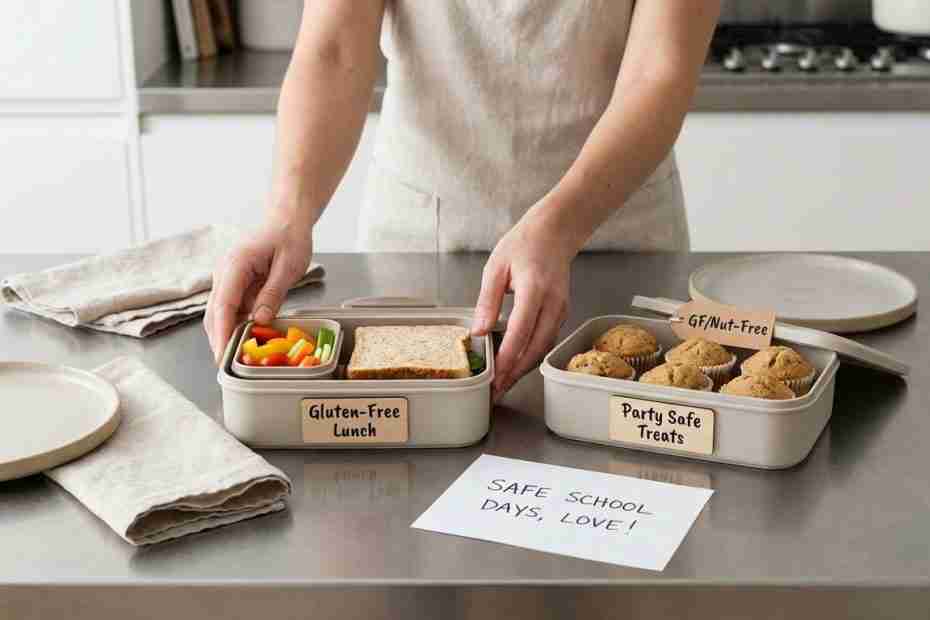
You can raise a gluten-free child who feels safe, included, and confident by locking in school protections early, standardizing party routines, and building picky-eater meals around naturally gluten-free staples plus a small set of trusted packaged backups. Your job is to reduce daily decision points, prevent cross-contact, and teach simple scripts your child can use without feeling “different.”
This guide focuses on the real-life pressure points parents report most, school lunches, classroom celebrations, birthday invites, label confusion, and selective eating. You’ll get clear actions, parent-ready scripts, and routines that hold up when staff changes, schedules get hectic, or another adult is handing out snacks.
How Do You Get Your Child Safely Accommodated At School, And Do You Need A 504 Plan?
If your child has celiac disease, treat school support like an operational requirement, not a favor. A formal plan reduces the risk that safety depends on one helpful teacher, a friendly cafeteria manager, or a nurse who later transfers. The goal is consistency across classrooms, specials, substitutes, and field trips, not a one-time conversation that fades by October.
A 504 plan is widely recommended in celiac organizations because it documents accommodations that follow your child across grade levels. National Celiac Association states that celiac disease is considered a disability and that a 504 plan is highly recommended for students who require a gluten-free diet, especially in public or charter schools. It also highlights that planning should include the nurse, teachers, and food service so the full school day gets covered, not just lunch.
Write the plan so it addresses the places gluten shows up unexpectedly: classroom rewards, science labs, art materials, group snacks, and holiday events. National Celiac Association lists sample accommodations that get specific about advance notice for food events, gluten-free alternatives to play dough and papier-mâché, and soap-and-water handwashing because sanitizer does not remove gluten. That level of detail matters because it turns “be careful” into steps staff can execute on a busy day.
Operationally, aim for a three-layer setup. Layer one is documentation, the 504 plus a doctor’s note if the district asks for it. Layer two is routines, cleaning surfaces with detergent, separating eating areas, and setting rules for shared supplies. Layer three is skill-building, teaching your child how to decline food, ask for help, and avoid trading snacks without turning every interaction into a debate.
Can The Cafeteria Really Provide Gluten-Free Meals, And Why Do So Many Families Still Avoid School Lunch?
Many schools can provide substitutions when a medical need is documented, yet families still opt out of school meals when trust and process fall short. Parents are not just reacting to menu limitations, they are reacting to uncertainty about prep surfaces, gloves, shared utensils, and how frequently staff training gets reinforced. The “can they” question matters less than the “will it be safe every day” question.
Caregiver survey reporting summarized by the Celiac Disease Foundation shows how common avoidance is. In that report, a large portion of children in the study group had never eaten free school meals, even when meals were available, and parents cited concerns that tie back to preparation safety, limited options, and weak communication. Those concerns mirror what shows up in parent communities: families often feel safer sending food from home than gambling on a system that changes day to day.
Make cafeteria safety measurable. Ask for a single point of contact, usually the cafeteria manager, lead cook, or district dietitian, so you are not re-explaining celiac disease to a rotating cast. Request weekly or monthly menus in advance and confirm which items are intended to be gluten-free, then ask what the kitchen does to prevent cross-contact. If the answer is vague, implement a home-lunch plan and treat cafeteria food as an occasional option only after the process proves itself.
Build a fallback that is not emotionally loaded. Stock a shelf-stable emergency kit that can sit with the nurse or teacher, a labeled snack, a safe meal replacement, a disposable placemat, and wipes for hands and surfaces. That backup keeps your child participating in routine school life when a classroom event pops up or a lunch item runs out, and it prevents “no food for you” moments that become social landmines.
What Should You Do About Classroom Parties, Birthday Treats, And Food Days So Your Child Isn’t Left Out?
Handle classroom parties by standardizing inclusion. The most effective pattern is a pre-approved treat stash that stays at school and a rule that your child eats only items from that stash or from a labeled, pre-checked source. Parents in celiac communities often describe sending a dedicated cupcake or treat portion that is kept separate so it cannot be mixed into a shared tray, especially when celebrations are last-minute.
Schools sometimes try to solve this by asking families to bring gluten-free treats for the whole class. Teachers and parents discuss this online, yet celiac families frequently remain cautious with homemade items because ingredient errors and kitchen cross-contact are common, even with good intentions. If the classroom allows it, store-sealed, individually wrapped items reduce ambiguity and make it easier for staff to distribute treats without handling or cutting food on crumb-covered surfaces.
Make the party plan visible and repeatable. Keep two or three options in the stash so your child gets variety without introducing constant new brands. Label everything with your child’s name and include a note that it is “gluten-free for medical reasons, no sharing.” Add a disposable plate or napkin in the same bag so the treat never touches a shared table or tray.
Coordinate with the teacher using a one-page note that answers the questions they always have: where the stash is stored, when they should contact you, and what to do when a surprise treat arrives. You also want agreement on non-food rewards so the classroom does not default to candy every time someone earns points. That single shift reduces exposure opportunities and lowers the social pressure your child feels when everyone is handed food as a “reward.”
How Do You Respond To Birthday Party Invites, Pizza Parties, And Playdates Without Sounding High-Maintenance?
Use a short RSVP script that removes work from the host. Your goal is to communicate “medical strict” without triggering a negotiation about whether a shared pizza is “close enough.” Parents in celiac communities often report success when they state the need briefly, offer to bring food, and attend the party so accidental sharing does not happen when adults get distracted.
Send the message early, then close the loop with a concrete plan. You are not asking the host to shop differently, clean their kitchen, or change the menu for everyone. You are protecting your child while keeping the event simple for the adults running it, which makes hosts more willing to say yes to playdates and repeat invitations.
Use a script like this in text or email: “Thanks for inviting [Child]. They have celiac disease, so they can’t have any gluten or shared food. We’ll bring their own pizza and cupcake so you don’t have to change anything.” If the host offers accommodations anyway, accept only what is easy to verify, like a sealed labeled item, and keep your plan to bring your own food.
On the day of the party, control the failure points. Pack your child’s meal in a separate container, bring a clearly labeled drink, and set a rule that your child eats only what you brought or what you personally checked. If your child is young, staying at the party is often the safest option, not because other adults do not care, but because parties are busy and food sharing happens fast.
What Does “Gluten-Free” Actually Mean On Labels, And What Cross-Contact Risks Matter Most For Kids?
In the United States, “gluten-free” is a defined labeling claim for FDA-regulated foods. FDA explains that products labeled “gluten-free,” “free of gluten,” “without gluten,” or “no gluten” must meet specific criteria, including a limit of less than 20 parts per million of gluten. That number matters because it sets the baseline expectation for what the label means when you are choosing packaged foods for school snacks or party backups.
Train yourself and your child to separate two risks: ingredient gluten and cross-contact gluten. Ingredient gluten is wheat, barley, rye, and foods derived from them. Cross-contact gluten is what happens when crumbs, flour dust, shared utensils, or shared condiments transfer gluten onto a food that started out gluten-free. That second category drives many of the school and party problems because a plain food can become unsafe in a shared environment.
At school, the common cross-contact hotspots are predictable. Shared tables in cafeterias get wiped quickly but remain crumb-heavy. Shared supplies can contain wheat-based binders or be handled by kids who just ate crackers. Food in the curriculum and art projects, play dough, papier-mâché, baking activities, also creates exposure paths that adults underestimate because they don’t think of “craft time” as “food time.” National Celiac Association sample accommodations address these points directly, including soap-and-water handwashing and avoiding flour dispersed into the air.
Use labeling rules as a tool, not as a guarantee. A “gluten-free” label is meaningful, yet environment still matters. A labeled snack dropped into a shared snack bin can get contaminated. A gluten-free cupcake cut with a knife that just touched regular cake becomes unsafe. Build habits that keep your child’s food physically separate, and teach staff to treat gluten like a material that transfers, not just an ingredient on a list.
How Do You Feed A Picky Eater On A Gluten-Free Diet Without Living On Packaged Substitutes?
Picky eating becomes harder when you remove common kid staples, and it becomes much harder when you also need strict cross-contact control. The fix is not “more gluten-free replacement products,” it is menu standardization paired with nutrient-dense, naturally gluten-free foods your child already tolerates. That approach reduces shopping complexity, reduces label scanning fatigue, and stabilizes your child’s appetite because meals feel familiar.
Build a tight rotation of safe meals and scale it across breakfast, lunch, and after-school snacks. A reliable template is one carb your child accepts, one protein they accept, and one fruit or vegetable that is easy and repeatable. Rice, potatoes, corn tortillas, eggs, yogurt, beans, cheese, chicken, fruit, and many vegetables can form a strong base without relying on specialty bread at every meal. Packaged gluten-free items still have a place, but they perform best as backups and convenience tools, not as your entire plan.
For school lunch, consistency is your advantage. Implement one “default lunch” your child eats with minimal negotiation, then rotate one optional side to prevent boredom. That prevents the pattern where a child rejects a new gluten-free product at school, trades food with a friend, and ends up exposed. It also reduces the chance that you are testing unfamiliar foods in the highest-risk setting, a cafeteria, a field trip, or a classroom party.
Make the home environment support the school environment. If your child relies on a specific gluten-free snack brand, keep it available at home so it stays familiar and accepted. If the child tends to snack graze, set fixed snack times so lunch hunger remains strong. This is not about controlling your child, it is about controlling the variables that lead to risky choices when a teacher offers crackers and your child is starving.
How Do You Teach Your Child To Self-Advocate Without Creating Food Anxiety?
Self-advocacy is a safety skill, not a personality trait. Your child does not need to become the “gluten expert” in the room, they need a few repeatable lines and the confidence to use them. You want calm refusal, quick redirection, and a default habit of checking with you or a designated adult when food appears.
Start with three scripts and practice them at home in a normal tone. Script one is for peers: “No thanks, I can’t eat that.” Script two is for adults: “I have celiac disease. Can you check with my teacher or my parent?” Script three is for uncertainty: “I only eat food from my lunchbox.” These lines keep your child from over-explaining and keep the interaction short, which reduces social friction.
Pair scripts with rules your child can remember. Rule one: no trading food, even if it looks safe. Rule two: no eating from shared bowls, bins, or platters. Rule three: if hands touched classroom materials or shared toys, wash with soap and water before eating. National Celiac Association’s guidance emphasizes soap-and-water handwashing and notes that sanitizer does not remove gluten, and that one detail alone prevents many accidental exposures at school.
Keep the emotional tone steady. If every food interaction becomes a high-alert moment, your child may push back to regain control or to fit in. Keep your wording neutral, focus on “safe food only,” and praise the behavior you want, asking before eating, declining politely, sticking with lunchbox food. Your child will still have hard days, yet consistent routines protect safety without turning meals into conflict.
What Should You Put In A 504 Plan For Celiac Disease?
- Advance notice before food events
- Soap-and-water handwashing, not sanitizer
- Clean eating surfaces with detergent
- Gluten-free art and classroom materials
- Safe lunch seating to reduce crumbs
Put Safety On Autopilot, Then Let Your Kid Be A Kid
A gluten-free childhood runs smoothly when you reduce surprises, write school expectations down, and stop relying on verbal promises that disappear with staff turnover. Lock in a 504 plan when celiac disease is in the picture, then build daily routines that handle classroom treats, cafeteria uncertainty, and last-minute party invites without stress spikes. Teach your child short scripts, keep safe backups at school, and standardize a picky-eater menu that does not depend on constant specialty shopping. The result is practical, your child eats safely, participates socially, and gains independence at a pace that matches their age. When routines are set, your time shifts away from constant policing and toward normal parenting again.
Want more parent-tested systems for school lunches, party scripts, and label-reading shortcuts? Visit medium profile to keep reading and pull the next guide when the next school email about “snack day” hits.
References
- National Celiac Association, “Does my child need a 504 plan?”
- FDA, “‘Gluten-Free’ Means What It Says”
- FDA, “Questions and Answers on the Gluten-Free Food Labeling Final Rule”
- Celiac Disease Foundation, “Challenges Persist for Students with Celiac Disease in Free School Meal Programs”
- Celiac Disease Foundation, “School Support”
- Reddit, r/Celiac, “Question for people with celiac as a child”
- Reddit, r/Celiac, “Teacher to all parents: Class birthday treats MUST be gluten free…”
- Reddit, r/glutenfree, “What to do for kids’ birthday parties?”
- Reddit, r/Celiac, “How to respond to a kid’s birthday invite?”
- Reddit, r/glutenfree, “Need some snack advice for a student of mine”