
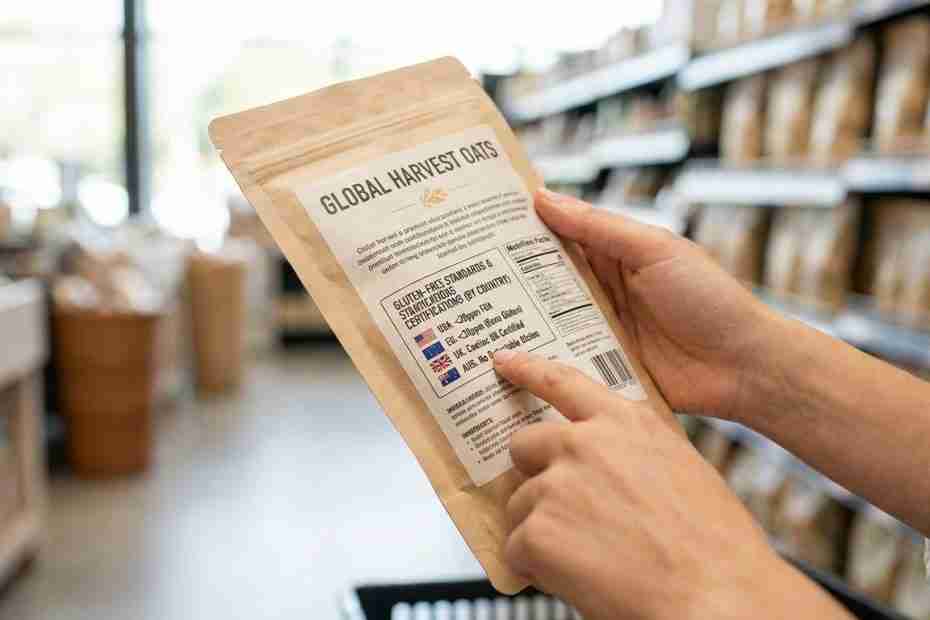
Gluten-free oats around the world are usually judged against the same gluten limit, 20 parts per million, but the United Kingdom and European Union, United States, and Canada label oats in different ways. The biggest difference is not the gluten limit; it’s how each region treats oats on the ingredient list and what proof or wording shoppers can expect.
If you buy oat milk, oatmeal, oat flour, granola, or snack bars across borders, those differences can be confusing fast. This guide explains how the rules work, why “gluten-free” does not always mean “oat-free,” and what you should check when choosing oat products for a gluten-free diet.
Are Gluten-Free Oats Labelled The Same Around The World?
No. The United Kingdom and European Union (UK/EU), United States (US), and Canada share a similar gluten-free limit, but they do not present oat information in the same way. You’ll often see the same number, 20 parts per million (ppm), also written as 20 milligrams per kilogram (mg/kg), yet the label wording can look quite different.
In the UK/EU, oats used in gluten-free foods must meet gluten limits and be specially produced, prepared, or processed to avoid contamination from wheat, rye, barley, or related grains. The oats still need to be declared and emphasised in the ingredients list under food information rules. That can look contradictory at first: a product can say “gluten-free” and still highlight “oats.”
In the US, the Food and Drug Administration (FDA) allows voluntary gluten-free claims when the food meets the federal gluten-free rule. Oats are treated as a non-gluten-containing grain for this rule, so oat products do not need a special “gluten-free oats” ingredient phrase or mandatory certification. In Canada, the label treatment is more explicit: specially produced oats must be clearly identified as “gluten-free oats” wherever oats are referenced.
|
Region |
Main Shopper Takeaway
|
|
UK/EU |
Look for the gluten-free claim, and expect oats to still be declared and emphasised. |
|
US |
Look for the gluten-free claim; certification can help confidence but is not required by law. |
|
Canada |
Look for “gluten-free oats” wording when oats appear in a gluten-free product. |
Why Oats Are Complicated On A Gluten-Free Diet
Oats are complicated because the grain itself is not treated the same way as wheat, rye, or barley, yet regular oats can pick up gluten-containing grains during growing, harvesting, transport, milling, or manufacturing. That’s why “oats” and “gluten-free oats” are not interchangeable terms for label reading. A plain bag of regular oats with no wheat listed can still be a poor choice for someone who must avoid gluten strictly.
The second issue is personal tolerance. International guidance recognises that oats can be tolerated by most, but not all, people who are intolerant to gluten. That caveat matters because a product can meet the legal gluten-free limit and still not suit every person with coeliac disease or celiac disease.
For practical shopping, separate three ideas in your mind: the crop, the production chain, and the finished-food claim. The crop may be oats, the production chain needs controls to avoid wheat, rye, and barley contact, and the finished food needs to meet the legal gluten-free standard in the country where it’s sold. When those pieces line up, you have a much stronger basis for trusting the product.
The International Baseline: Codex And The 20 Ppm Standard
The Codex Alimentarius standard is the useful starting point because it explains why the 20 ppm number appears across many gluten-free rules. Codex defines gluten-free foods for people intolerant to gluten as foods that do not exceed 20 mg/kg gluten in the food as sold or distributed. Since 20 mg/kg equals 20 ppm, shoppers often see those terms used side by side.
Codex also recognises a separate category for foods specially processed to reduce gluten to more than 20 mg/kg and up to 100 mg/kg. That reduced-gluten category is not the same as gluten-free. It also leaves room for national authorities to decide how that category may be marketed in their own countries.
Oats are where Codex gives countries room to choose. It notes that oats may be tolerated by most but not all people who are intolerant to gluten, and says countries can decide whether to allow oats that are not contaminated with wheat, rye, or barley. That’s why your oat label can change from London to New York to Toronto, even when the gluten-free threshold looks familiar.
UK And EU: Gluten-Free Oats Must Meet Gluten Limits And Still Be Declared
In the European Union, Regulation (EU) No 828/2014 sets rules for statements about the absence or reduced presence of gluten in food. “Gluten-free” can be used only when the food contains no more than 20 mg/kg gluten. “Very low gluten” can be used for certain specially processed foods that contain no more than 100 mg/kg gluten.
For foods containing oats and carrying a gluten-free or very low gluten statement, the oats must be specially produced, prepared, or processed to avoid contamination by wheat, rye, barley, or their crossbred varieties. The oats themselves must not exceed 20 mg/kg gluten. This means the oat supply chain matters, not just the final recipe.
The United Kingdom Food Standards Agency follows the same practical labelling logic. If a product uses specially produced oats and meets the gluten-free rules, it may carry the claim, but the cereal still needs to be declared and emphasised in the ingredients list. So if you see “gluten-free” on the front and bold “oats” in the ingredients, that is not automatically a warning sign; it can be the required way to identify the cereal ingredient.
United States: FDA Allows Gluten-Free Oats Without Requiring Certification
In the United States, gluten-free labelling is voluntary, but once a food uses the claim, it must meet the Food and Drug Administration rule. The same rule applies to “gluten-free,” “free of gluten,” “without gluten,” and “no gluten.” Any unavoidable gluten must be below 20 ppm, and the food must avoid prohibited gluten-containing grain ingredients unless they meet the rule’s conditions.
The Food and Drug Administration treats oats as a non-gluten-containing grain for its gluten-free labelling guidance. Oats labelled gluten-free do not have to be certified by a third-party program. They still must contain less than 20 ppm gluten, so the claim carries a legal obligation even without a certification logo.
The Food and Drug Administration does not require manufacturers to test every starting ingredient or finished food labelled gluten-free. The manufacturer remains responsible for compliance with federal requirements. The agency has also conducted surveillance sampling of gluten-free labelled products, which helps explain why legal responsibility, manufacturing controls, and enforcement all matter in the US system.
Canada: “Gluten-Free Oats” Must Be Clearly Identified
Canada handles oats with extra label clarity. Canadian rules restrict gluten-free claims when a food contains gluten protein or modified gluten protein from wheat, oats, barley, rye, triticale, or their hybridized strains. Health Canada then permits gluten-free claims for specially produced “gluten-free oats” and foods containing them when set conditions are met.
Health Canada defines gluten-free oats as oats that do not contain more than 20 ppm gluten from wheat, rye, barley, or their hybridized strains. The finished food also must not contain more than 20 ppm gluten from those grains, must not contain intentionally added gluten from those grains, and must use only specially produced gluten-free oats when oats are present. Regular oats that do not meet these conditions are not treated the same way.
The most visible difference for you is wording. In Canada, gluten-free oats must be clearly identified as “gluten-free oats” wherever oats are referenced, including the ingredient list. If you’re used to US labels that simply list “oats” under a gluten-free claim, Canadian labels can feel more specific because the rules push that wording directly onto the package.
Side-By-Side Comparison Table
The easiest way to compare the regions is to separate the gluten limit from the oat disclosure rule. The gluten limit is broadly aligned around 20 ppm for gluten-free foods. The oat wording and ingredient-list treatment are where the systems split.
Use this table when you’re checking oatmeal, oat milk, oat flour, cereal, granola, or protein bars abroad. It does not replace medical advice or manufacturer confirmation, but it gives you a fast label-reading map. If you need strict gluten avoidance, the local claim on the package matters more than assumptions based on labels from another country.
|
Region |
Legal Gluten-Free Limit |
Are Oats Allowed? |
Must Oats Be Specially Produced? |
Must Ingredients Say “Gluten-Free Oats”? |
Is Certification Required? |
Shopper Takeaway
|
|
UK/EU |
No more than 20 mg/kg |
Yes, if rules are met |
Yes, to avoid contamination |
No, but oats must still be declared and emphasised |
No |
A bold oat ingredient can still appear on a gluten-free food. |
|
US |
Less than 20 ppm |
Yes, if the gluten-free rule is met |
Controls are needed to meet the limit, but special oat wording is not required |
No |
No |
The gluten-free claim is the main legal signal. |
|
Canada |
Health Canada uses 20 ppm as the safety threshold for gluten-free oats and finished foods |
Yes, if specially produced gluten-free oats are used |
Yes |
Yes |
No |
Look for “gluten-free oats” wherever oats are named. |
The table also shows why imported foods can feel confusing. A product made for one market may need a different label when sold in another market. If a food is sold in the US with a gluten-free claim, it must meet US requirements; the same practical idea applies when products are sold under UK/EU or Canadian rules.
Gluten-Free Vs Certified Gluten-Free: What The Logos Add
“Gluten-free” is a legal claim. “Certified gluten-free” is usually a private program claim added by a third-party certification body. The legal claim tells you the product must meet the applicable law in the place where it is sold, and the certification mark tells you the product has gone through an added program with its own requirements.
In the US, the Food and Drug Administration does not endorse, accredit, or recommend a specific third-party gluten-free certification program. Some private programs use tighter testing rules than the legal baseline. Gluten-Free Certification Organization, for one, says its standard requires starting ingredients and finished products to test below the applicable gluten-free threshold in the country of sale or 10 ppm, whichever is lower.
Certification can be useful if you want extra confidence, especially for oat-heavy products where cross-contact is a known concern. It does not mean every person will tolerate oats. If oats have caused ongoing symptoms for you, the label can help you avoid gluten exposure, but your own clinical guidance still matters.
Common Label Scenarios And What They Mean
A product that says “gluten-free” and lists oats can be legitimate. In the UK/EU, oats may still be emphasised in the ingredients because cereals need declaration under food information rules. In Canada, you should expect clearer wording, usually “gluten-free oats,” when oats are used in a gluten-free product.
A product that says “wheat-free” is not the same as a product that says “gluten-free.” Gluten can come from barley, rye, triticale, and related grains, not just wheat. If you need gluten avoidance for celiac disease or coeliac disease, “wheat-free” alone does not give you the same information as a regulated gluten-free claim.
A “may contain wheat” statement on a gluten-free product can be confusing because precautionary statements and gluten-free claims serve different label functions. The gluten-free claim still needs to meet the legal gluten limit. If the combination makes you uncomfortable, choose a certified product, contact the manufacturer, or pick an oat-free product with clearer risk controls.
- “Gluten-free” plus oats: Check whether the claim is made in the country where the product is sold.
- “Gluten-free oats”: Especially useful in Canada, where that wording is required when the conditions apply.
- Bold “oats” in UK/EU ingredients: This can be required disclosure, not proof the product contains unsafe gluten.
- “Wheat-free” only: Do not treat it as a gluten-free claim.
- Certification logo: Treat it as an added layer, not a guarantee of personal oat tolerance.
Travelling Or Buying Imported Oat Products: What To Check
When you travel, read the label by the country of sale, not by habits from home. In the UK/EU, check for “gluten-free” or “very low gluten,” then read the ingredients for oat disclosure. In the US, check whether the package uses one of the Food and Drug Administration’s gluten-free claim phrases.
In Canada, pay close attention to whether oats are identified as “gluten-free oats.” That phrase tells you the product is using the special oat pathway Health Canada permits for gluten-free claims. If the ingredient list only says regular oats and the package does not make a gluten-free claim, don’t treat it as equivalent.
For cross-border shopping, build a short routine. Look for the local gluten-free claim, check whether oats are ordinary or specially identified, review precautionary statements, and look for a trusted certification mark if you want extra assurance. When the product is medically necessary for you, contact the manufacturer or choose a simpler product with clearer labelling.
Are Gluten-Free Oats Labelled Differently In The UK/EU, US, And Canada?
- Yes. All three use about 20 ppm.
- UK/EU labels still declare oats.
- US labels don’t require oat certification.
- Canada requires “gluten-free oats” wording.
What This Means For Your Next Oat Label
Gluten-free oats around the world share a familiar number, but they do not share one single label style. The UK/EU puts weight on special oat production and continued oat declaration, the US relies on the regulated gluten-free claim without mandatory oat certification, and Canada makes the oat wording more direct with “gluten-free oats.” Regular oats are not the same as gluten-free oats, and “wheat-free” is not the same as gluten-free. If you tolerate oats and need strict gluten control, your best move is to read the local claim, check the oat wording, and use certification or manufacturer contact when the label leaves doubt.
References
- Codex Alimentarius — Standard for Foods for Special Dietary Use for Persons Intolerant to Gluten, CXS 118-1979
- EUR-Lex — Commission Implementing Regulation (EU) No 828/2014
- United Kingdom Food Standards Agency — Food Allergen Labelling And Information Requirements Technical Guidance
- United Kingdom Food Standards Agency — Oats (Gluten-Free) Data Code
- Coeliac UK — Gluten And The Law
- Food And Drug Administration — Questions And Answers On The Gluten-Free Food Labeling Final Rule
- Food And Drug Administration — Gluten And Food Labeling
- Food And Drug Administration — Gluten-Free Food Product Surveillance Sampling
- Code Of Federal Regulations — 21 CFR 101.91 Gluten-Free Labeling Of Food
- Health Canada — Gluten-Free Labelling Claims For Products Containing Specially Produced “Gluten-Free Oats”
- Canadian Food Inspection Agency — Allergen-Free, Gluten-Free And Cross-Contamination Statements
- Health Canada — Celiac Disease
- Celiac Canada — Oats Statement
- Gluten-Free Certification Organization