
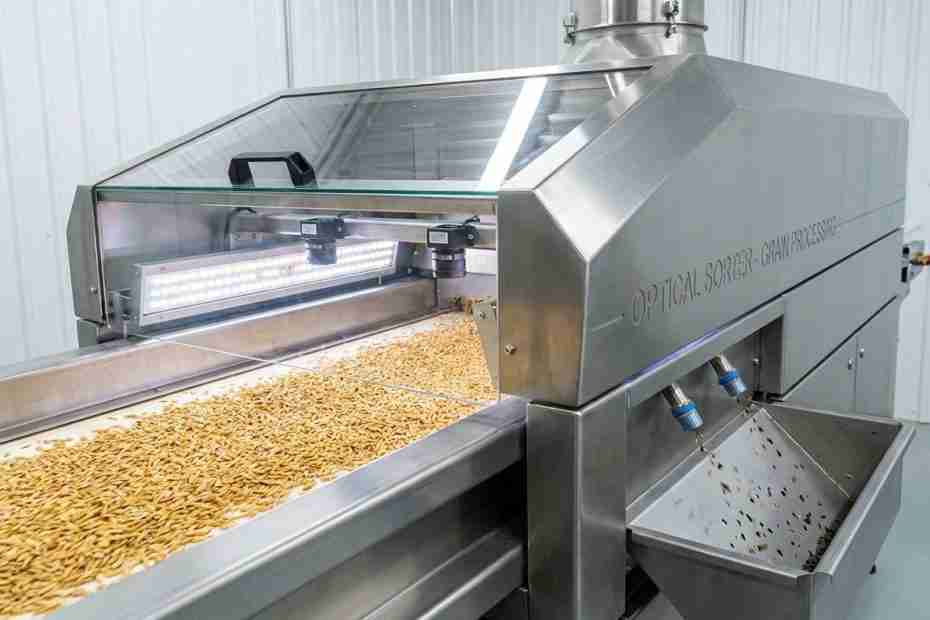
Optical sorting removes what a machine can reliably detect as different from good oats, usually by color, shape, surface condition, or a specific sensor signature. It works well as a precision cleaning step, but it does not magically remove every hull fragment, every insect piece, or every chemical hazard hiding inside normal-looking oats.
If you need to understand what optical sorters actually do in an oat mill, you need a practical view, not marketing shorthand. This article gives you that practical view, showing where optical sorting fits in the line, what it removes well, where it struggles, and what other equipment carries the load when optics reach their limit.
What Is Optical Sorting In Oat Milling?
Optical sorting is a sensor-based separation step that evaluates individual pieces of product as they move past cameras or other detectors. The machine compares each oat, groat, or fragment against programmed accept and reject rules, then uses fast air jets to eject the pieces that do not fit the target profile.
In oat milling, you should think of it as a finishing or precision-cleaning tool rather than the whole cleaning system. By the time oats reach the sorter, the line has usually already removed a large share of coarse foreign material through screens, aspiration, magnets, destoners, and dehulling equipment. That upstream work matters because optical sorters perform best when product is flowing evenly, pieces are separated from each other, and the stream is already fairly clean.
The machine’s value comes from selective rejection. You are not just pushing everything through one more cleaner. You are asking the system to identify what looks wrong, what is discolored, what is broken, what is diseased, what is not an oat, or what has a different optical signature than sound product. That gives you tighter purity control without discarding as much good product as a rough mechanical separation would.
Modern systems may combine red, green, blue imaging, shape analysis, near-infrared sensing, indium gallium arsenide sensing, and, in some installations, a separate X-ray unit for dense foreign material. That layered detection expands what you can identify, though it still depends on one basic rule: the contaminant has to differ enough from good oats for the machine to see it and act on it.
Where Does Optical Sorting Fit In The Oat Cleaning Line?
You should place optical sorting mentally near the back half of the cleaning and milling process, not at the front gate. Raw oats arrive with a mix of field material, dust, weed seeds, stones, stems, chaff, metal, and grain defects. Mills first rely on mechanical systems to reduce that bulk contamination load before any camera-based machine makes fine decisions.
A typical line starts with intake cleaning, screening, aspiration, and magnetic separation. From there, the oats may move through grading, destoning, and dehulling. Once the hulls are removed and the groats are cleaner and more uniform, optical sorting becomes much more useful because the product stream is easier to inspect piece by piece.
This sequence matters for performance and yield. If you feed a sorter a dirty, inconsistent stream full of dust clouds, clumps, overlapping kernels, and excess plant material, your reject rate rises and your accuracy falls. Good mills do not ask one machine to solve a process problem created upstream. They stage the equipment so each unit handles the kind of separation it does best.
That is why optical sorting is often described as a polishing step. It can sharpen final quality, reduce visible defects, and help remove oat-sized material that screens cannot separate by dimensions alone. It is not a replacement for sound intake standards, dehulling efficiency, aspiration balance, or line maintenance.
What Contaminants Can Optical Sorters Remove Well From Oats?
Optical sorters perform best when the unwanted material looks different from sound oats in a consistent, detectable way. That includes defects tied to color, darkness, staining, unusual surface texture, odd silhouette, breakage, or species differences that present a different visual or spectral signature.
In practical oat processing, that often means foreign grains, discolored kernels, insect-damaged grains, broken kernels, some diseased material, and visible non-oat pieces that stand out from the product stream. If you are trying to remove oat-sized defects that mechanical screens cannot separate, this is where optical sorting earns its place.
You should also expect strong performance on contaminants that are stable in appearance from lot to lot. Machines perform better when reject criteria are clear and repeatable. A dark ergot body, a badly stained kernel, or a clearly off-color foreign seed gives the sorter something concrete to identify. A pale hull fragment that resembles a thin oat sliver is a much tougher job.
The real advantage is selectivity at throughput. A trained operator can tune sensitivity, sort recipes, and reject thresholds to protect finished quality while limiting good product loss. That balance matters in commercial milling because every point of rejected yield has a cost. The best sorting program is not the one with the most aggressive reject setting. It is the one that removes the highest-risk defects without dumping saleable oats into the reject stream.
Can Optical Sorters Remove Oat Hulls And Husk Fragments?
They can remove some hulls and husk fragments, but you should not expect perfect separation. Hull material is one of the most misunderstood parts of oat cleaning because it sits right on the edge between what mechanical systems should remove and what optical systems may be able to clean up.
The dehuller and aspiration system carry the main burden here. If hull removal upstream is weak, the sorter inherits a difficult job. Thin, pale, lightweight fragments can behave unpredictably in the product stream. They may overlap with oats, flutter in ways that reduce image quality, or appear close enough in color and reflectance that the sensor has little basis for a clean decision.
Shape-based sorting can improve hull reduction when fragments present a distinct silhouette. Belt sorters may also help in some applications because they can present material in a more controlled way than free-fall systems. Even with those advantages, hull fragments that resemble broken oat pieces create a trade-off. Tighten the reject settings too much and you start losing acceptable product along with the hulls.
If your main quality complaint involves hull carryover, you should inspect dehulling performance, aspiration balance, and stream presentation before assuming the optical sorter is underperforming. In most mills, optics help polish hull removal, but they do not replace the upstream systems that are designed to do the heavy lifting.
Can Optical Sorters Remove Insects And Insect Fragments From Oats?
Whole insects and larger visible insect pieces may be removed when the machine can clearly distinguish them from oats. That usually requires enough contrast in color, texture, size, or shape, plus a presentation that lets the sensor see the object cleanly. If the insect is exposed, intact, and visually different, the odds improve.
Small fragments are a different matter. Once insect material breaks into tiny pieces, mixes with dust, or resembles small oat fragments, sorting becomes much less reliable. The ejection system also has practical limits. A machine can only reject what it can detect and physically separate in real time.
This is where you need realistic quality language. In food processing, the goal is reduction and control, not fantasy-level claims that every microscopic fragment can be eliminated. Consumer complaints often come from tiny dark or tan pieces found in oatmeal that may be hull material, bran, toasted particles, or insect matter. A visual sorter does not have the power to settle every one of those edge cases with perfect certainty once the pieces become too small or too similar to the product.
If insect control is a serious concern in your operation, you need more than sorting. Storage conditions, pest management, sanitation, raw material controls, and inspection plans all matter. Optical sorting supports that program by removing visible defects, but it does not replace the broader preventive controls that determine whether insects become a recurring issue.
Can Optical Sorting Reduce Mycotoxin And Ergot Risk In Oats?
Yes, but only indirectly and only under the right conditions. Optical sorting can reduce risk by removing kernels or grain bodies that are visually linked to contamination, especially when the contaminated fraction is discolored, malformed, shriveled, or otherwise distinguishable from sound oats.
Ergot is the clearest example. Ergot bodies often differ enough in appearance that cleaning and optical separation can reduce their presence. When diseased or contaminated material presents a visible marker, the sorter can target that marker and reject the affected fraction. That can improve food safety performance and support tighter finished-product control.
Mycotoxins are more complicated. A machine does not remove a dissolved chemical from the interior of a normal-looking oat. It removes oats or fragments that are more likely to carry elevated contamination. If the toxin is associated with visibly damaged or abnormal kernels, sorting can lower the load. If the contaminated oats look normal, optics have little to work with.
You should treat mycotoxin control as a multi-step process. Raw grain sourcing, incoming testing, cleaning, dehulling, density separation, sorting, and finished-product verification all matter. Optical sorting is one useful control point in that chain, though it is not a chemical removal system and should never be framed that way.
What Can Optical Sorters Not Remove From Oats?
Optical sorters struggle with anything that does not appear meaningfully different from good oats. If the contaminant matches the product in color, shape, reflectance, and apparent size, the machine has little basis to classify it correctly. That limitation is not a flaw in one brand or one model. It is the basic boundary of sensor-based visual separation.
Embedded contaminants are another limit. If a defect sits inside the groat and does not change the outside appearance enough for the sensor to detect it, the sorter will not catch it reliably. The same applies to chemical hazards that do not produce a usable external signal. A machine looking at surfaces cannot remove what it cannot perceive.
Very small fragments also fall into the problem zone. Dust, tiny splinters, powdery residues, and minute particles are often below practical detection or ejection limits. Even when a sensor picks up some of these particles, the airflow physics of precise rejection become less dependable as particle size drops and throughput rises.
You should also be cautious with low-contrast plant material. Pieces of stem, pale husk, or oat-like foreign grain can sit close enough to the accepted product profile that clean separation costs too much yield. Mills often accept a more balanced setting rather than chasing an unrealistic purity target that creates unnecessary waste.
What Machines Remove The Contaminants Optical Sorters Miss?
No oat mill should rely on one machine family to do every cleaning job. Mechanical cleaning remains the backbone of the line because many contaminants differ from oats by size, weight, density, or aerodynamic behavior rather than by visual appearance. Screens remove overs and unders. Aspirators remove light material. Destoners remove dense heavy particles. Magnets capture ferrous metal.
Dehullers and related separation equipment are central in oat processing because oats arrive with an inedible outer hull. If the dehulling step is not well tuned, downstream optical equipment spends too much effort chasing hull remnants and broken material instead of refining final quality. That raises reject rates and reduces efficiency.
X-ray systems address a different class of hazard. They are used for dense foreign bodies like metal, glass, stone, and some high-density plastics that may not stand out optically. If your contamination concern is tied to density rather than color or shape, optics alone are not enough. You need a detection method matched to that physics.
The strongest plants build a layered defense. You use intake controls to reduce what enters the facility, mechanical systems to strip out bulk foreign material, dehulling and aspiration to manage oat-specific separation, optical sorting to catch visible defects and off-types, and downstream inspection to verify the final result. That layered design gives you a far better outcome than pushing one machine beyond what it was built to do.
How Should You Judge Optical Sorting Performance In Oat Processing?
You should judge performance by purity, yield, consistency, and defect reduction, not by the claim that the machine can remove everything. A sorter can look impressive in a demo and still underperform in a live mill if the feed rate is unstable, the product stream is dirty, lighting calibration drifts, or reject settings are too aggressive for the incoming crop.
The right question is not whether the sorter catches every defect. The right question is whether it removes the right defects at an acceptable yield loss and does so consistently over time. That means you need baseline defect data, reject analysis, recipe management, verification checks, and regular maintenance discipline.
Operators often make the mistake of chasing visual perfection on the finished sample without tracking what is leaving in the reject bin. If your reject stream contains too many good oats, you are buying purity with unnecessary product loss. If your finished oats still show too many defects, you may need better upstream cleaning, recipe tuning, or a different sensor setup.
Performance also shifts by oat crop, supplier, field conditions, moisture, defect type, and finished product target. A setting that works well for one lot may not be ideal for the next. Skilled mills treat optical sorting as a managed process variable, not a machine they set once and forget.
What Should You Tell Customers About What Machines Can And Can’t Remove?
You should tell customers the truth in plain language. Optical sorting is very good at removing visible, detectable defects that differ from sound oats. It improves purity, appearance, and defect control, especially when it sits inside a well-run cleaning system.
You should also explain that no oat mill can promise the complete removal of every tiny fragment of hull, bran-like particle, insect material, or naturally occurring defect. Food manufacturing reduces risk through multiple cleaning and inspection steps, and optical sorting is one of the strongest tools in that sequence. It is not a guarantee that every microscopic or look-alike fragment will be eliminated.
This kind of explanation builds trust because it matches how milling actually works. Customers do not need inflated claims. They need a credible description of the controls in place, the purpose of the machinery, and the limits that apply when particles become too small or too similar to good product.
If you communicate with precision, you protect your brand and your quality team at the same time. Overselling one machine creates unrealistic expectations. Clear process language sets a better standard and gives customers a more accurate picture of how oats are cleaned and sorted before they reach the shelf.
What Can Optical Sorting Remove From Oats?
- Removes visible defects, discolored kernels, some foreign grains, some diseased material, some broken oats.
- May reduce hull fragments and visible insects, but not perfectly.
- Does not reliably remove microscopic fragments, hidden defects, or dissolved chemical hazards.
- Works best with screens, aspiration, dehulling, magnets, destoners, and X-ray inspection.
Use Optical Sorting For What It Does Best
If you understand optical sorting as a precision tool rather than a universal fix, you make better decisions about oat quality, equipment selection, and customer communication. The machine excels at identifying and ejecting product that looks different from acceptable oats, and that makes it a strong control point for visible defects and certain contamination risks. Its limits show up when contaminants become too small, too hidden, or too similar to the product stream. Your best results come from pairing optical sorting with solid dehulling, aspiration, mechanical cleaning, and verification checks. When you frame it that way, you set realistic expectations and build a cleaner, more dependable oat processing line.
References:
- https://en.wikipedia.org/wiki/Optical_sorting
- https://www3.epa.gov/ttn/chief/ap42/ch09/final/c9s0909-1.pdf
- https://www.buhlergroup.com/global/en/products/sortex_a_colorvisionopticalsorter.html
- https://www.buhlergroup.com/global/en/process-technologies/Optical-Sorting/Grain-sorting.html
- https://www.satake-europe.com/cereals/oats-barley
- https://satake-usa.com/product/satake-beltuza-optical-belt-sorter/
- https://www.tomra.com/en-gb/food/categories/seeds-and-grains
- https://www.fda.gov/food/ingredients-additives-gras-packaging-guidance-documents-regulatory-information/food-defect-levels-handbook
- https://www.reddit.com/r/Oatmeal/comments/17ou4mw/are_these_hulls_or_insect_parts/
- https://www.food.gov.uk/research/chemical-hazards-in-food-and-feed/monitoring-the-presence-of-ergot-alkaloids-in-cereals
- https://www.grainscanada.gc.ca/en/grain-research/scientific-reports/mycotoxin-processing/
- https://d3pcsg2wjq9izr.cloudfront.net/files/8015/download/731915/12BrochureIxus-EN.pdf