
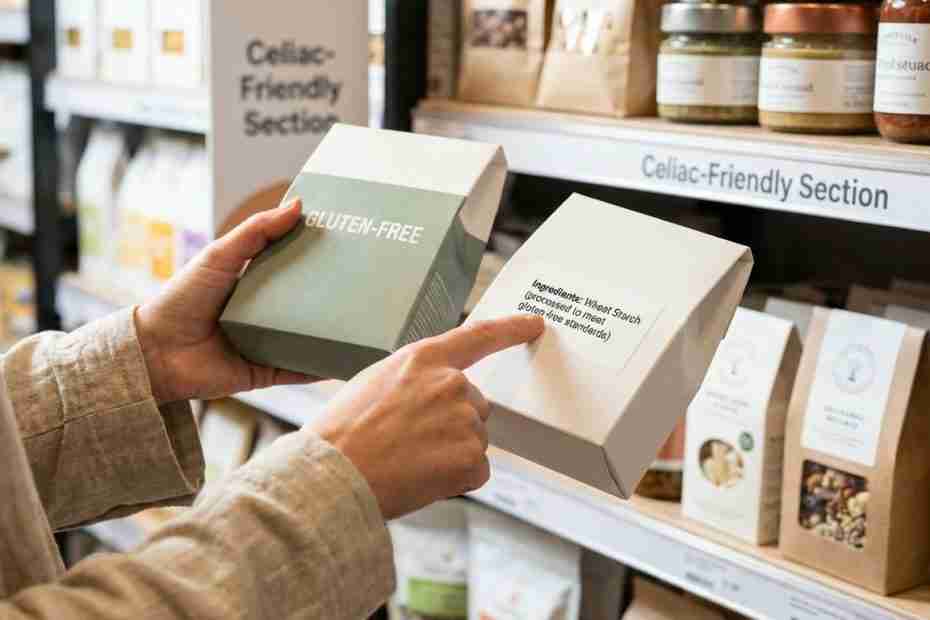
Yes, wheat starch can be safe for celiac disease when it has been processed to remove gluten and the finished food still meets the legal gluten-free standard. The confusion starts because a product can contain a wheat-derived ingredient and still qualify as gluten-free for celiac disease, but that does not make it suitable for a wheat allergy.
If you have celiac disease, you need more than a yes-or-no answer. You need to know what wheat starch is, why it appears in gluten-free breads and pizza, what food labels actually mean, where expert opinions differ, and how to judge whether a product deserves your trust. This explainer gives you that practical reading of the issue, so you can make faster and safer decisions in the store, online, and when comparing products from the United States and Europe.
Is Wheat Starch Safe For People With Celiac Disease?
For many people with celiac disease, wheat starch can be safe when it has been specially processed to remove gluten and the final food contains less than 20 parts per million of gluten. That threshold matters in the United States because gluten-free labeling is tied to the amount of gluten present in the finished food, not simply to whether the ingredient originally came from wheat. If a manufacturer uses wheat starch that has been refined to remove gluten and the final product stays below the legal limit, the product can qualify as gluten-free under federal rules.
This point surprises a lot of shoppers because “wheat” and “gluten” get treated like interchangeable terms in everyday conversation. For celiac disease, the real trigger is gluten, the protein fraction that causes an immune reaction and intestinal injury. Wheat starch is the starch portion of wheat, not the gluten portion, so if the gluten has been removed to a low enough level, the ingredient may fit into a gluten-free product. That does not mean all wheat starch is automatically safe. It means safety depends on processing, testing, labeling, and the final gluten level in the food you are buying.
You also need room for practical caution. Regulatory agencies and several major celiac-focused organizations accept properly processed wheat starch in gluten-free foods, yet some specialists and patient advocates remain more careful about it. Their concern centers on whether testing always captures gluten accurately in every product type and whether all manufacturers maintain tight enough controls batch after batch. So the honest answer is not a blanket yes. The stronger answer is this: wheat starch can be safe for celiac disease, but only when it is processed and verified well enough to keep the final product under the gluten-free limit.
How Can Something Made From Wheat Still Be Labeled Gluten-Free?
This is the labeling issue that confuses people the most, and for good reason. You might pick up a loaf of bread, see “gluten-free” on the front, turn it over, and find “wheat starch” in the ingredient list. At first glance, that looks like a labeling mistake. It is not. Gluten-free labeling rules and wheat allergen labeling rules are separate systems, and a product may need to follow both at the same time.
Under food labeling rules in the United States, an ingredient derived from a gluten-containing grain can appear in a gluten-free food if that ingredient has been processed to remove gluten and the finished product remains under the legal threshold. Wheat starch is the classic example. Regular wheat flour would not qualify because it still contains gluten at a level that matters. Wheat starch may qualify if gluten has been removed sufficiently and the finished food still tests within the allowed range.
This is why you may also see an allergen disclosure that mentions wheat. From a celiac disease standpoint, that does not automatically make the product unsafe. From a wheat allergy standpoint, it may still be a problem. That distinction matters a great deal. If you are reading labels for celiac disease management, your question is whether the gluten content in the final food meets the gluten-free standard. If you are reading labels for a wheat allergy, the presence of a wheat-derived ingredient can rule the product out, even when the gluten level is low.
The practical lesson is simple: do not stop at a single word on the package. Read the front-of-pack claim, the ingredient list, and the allergen statement together. When those pieces appear to clash, the product may still be compliant. You just need to interpret it through the correct lens.
What Does The Food And Drug Administration Say About Wheat Starch In Gluten-Free Foods?
The Food and Drug Administration allows wheat starch in foods labeled gluten-free when the starch has been processed to remove gluten and its use does not cause the finished food to contain 20 parts per million or more of gluten. That is the central rule you need to know. It is also why wheat starch remains one of the most misunderstood ingredients in the gluten-free category. The ingredient name sounds incompatible with celiac safety, yet the actual legal test is based on residual gluten in the final product.
The agency’s explanation is important because it does not treat all ingredients from gluten-containing grains the same way. Some ingredients from wheat, barley, or rye cannot be used in gluten-free labeled foods because the gluten is still present in a meaningful amount. Others, including ingredients processed to remove gluten, may be used if the final food still meets the standard. Wheat starch sits in that second category when properly refined. That distinction shapes the entire market for gluten-free breads, pizza crusts, pastries, and flour blends that aim for a texture closer to conventional baked goods.
Patient guidance from the National Institute of Diabetes and Digestive and Kidney Diseases also supports the practical use of labeled gluten-free foods and reminds patients to read labels carefully and contact the manufacturer if something remains unclear. That matters because compliance lives in the finished product, not just in the ingredient theory. A company can describe an ingredient as processed, but you still need confidence that the final food is controlled, tested, and labeled correctly.
You should also know that regulators have shown continued interest in clearer gluten ingredient disclosure. That does not change the current rule on wheat starch, yet it does confirm what many shoppers already feel in the aisle: labeling language around gluten and wheat still causes avoidable confusion. Until those rules become easier for everyday shoppers to parse, the burden stays on you to understand how the system works.
Is Wheat Starch Safe For Celiac Disease But Not For Wheat Allergy?
Yes. A product can be suitable for many people with celiac disease and still be unsuitable for someone with a wheat allergy. Those are different medical issues with different triggers. Celiac disease is an autoimmune condition driven by gluten exposure. A wheat allergy is an allergic reaction to wheat proteins. A food can be processed so that its gluten content falls low enough for gluten-free labeling, yet still require wheat disclosure because the ingredient came from wheat.
This is the part many online conversations compress into a quick line that leaves out the detail you need. Saying “safe for celiac, not safe for wheat allergy” is a decent starting shorthand, but it only works when the product actually meets gluten-free standards. If a product contains ordinary wheat starch or uses wheat-derived ingredients without proper gluten removal and validation, that shorthand falls apart. The product has to earn the gluten-free claim through processing and final compliance.
The difference matters beyond food packaging. In patient guidance outside the food aisle, wheat starch with very low gluten content has also been discussed as acceptable for many people with celiac disease while still being inappropriate for a wheat allergy. That reinforces the same principle across product categories: celiac disease management and wheat allergy management are not the same task. If your household includes both conditions, you need a stricter reading of labels and often a separate product-selection routine.
So when you see “contains wheat” on a product labeled gluten-free, do not assume the label is broken. Instead, ask the right question. Is the issue gluten exposure for celiac disease, or wheat exposure for allergy management? That single shift in thinking clears up a large share of the confusion around wheat starch.
Why Do So Many Gluten-Free Breads And Pizzas In Europe Contain Wheat Starch?
You will notice wheat starch more often in European gluten-free breads, pastries, and pizza products because it performs exceptionally well in baking. It improves stretch, chew, rise, browning, and overall structure in ways many starch-only or rice-based blends struggle to match. If you have ever wondered why some gluten-free products feel dry, crumbly, or fragile, the answer often comes down to formulation. Wheat starch can help manufacturers build a product that acts more like traditional wheat-based dough once the gluten has been removed to acceptable levels.
There is also a market-history reason behind this. In the United Kingdom and parts of Europe, gluten-free wheat starch has long been used in specialty substitute foods, and shoppers there are generally more accustomed to seeing it in products designed for people with celiac disease. That familiarity changes expectations. In the United States, many consumers still assume that a gluten-free item should contain no wheat-derived ingredients at all, so the appearance of wheat starch triggers suspicion much faster.
From a food performance angle, the attraction is easy to understand. Companies want gluten-free bread that slices cleanly, pizza dough that bends rather than cracks, and pastries that do not collapse into dust. Gluten-free wheat starch can help deliver that outcome. Some product makers in the United States have leaned into that benefit and publicly explain their testing process, including the methods used and the gluten target for the final flour or dough blend.
If you shop internationally or order specialty products online, this difference in market habits matters. A gluten-free label on a European or United Kingdom product may come with ingredient patterns that feel unfamiliar if you are used to standard American supermarket shelves. The product may still be acceptable for celiac disease under the applicable rules, but you need to read labels with care and avoid assuming that a different ingredient style means automatic danger.
Should People With Celiac Disease Avoid Wheat Starch Anyway?
That decision comes down to your comfort level, symptom history, trust in the manufacturer, and how conservative you want your food choices to be. Legally and medically, properly processed wheat starch can fit into a gluten-free diet for celiac disease. Yet a portion of the celiac community still avoids it on purpose. Some people do so because they have had reactions they connect to specific products. Others do so because they do not trust every company to control gluten removal and testing with enough consistency.
There is also a more technical reason some experts stay careful. Testing gluten in certain processed foods is not always as straightforward as consumers assume. The closer a product gets to the threshold, the more attention you should pay to the manufacturer’s quality controls, sourcing, and transparency. A legal standard helps, but it does not replace judgment. If a company provides little detail, hides behind vague marketing language, or cannot answer questions about testing and manufacturing controls, caution is justified.
You should also separate symptoms from certainty. Some people assume a product is safe because they feel fine after eating it. Celiac disease does not always produce immediate, obvious symptoms with every exposure. Damage can occur without a dramatic reaction. On the other side, some people feel unwell after eating a product that still meets the gluten-free standard, which can happen for reasons unrelated to gluten alone, including fiber changes, gums, fermentation issues, or individual digestive sensitivity. That is why wheat starch decisions often become personal even when the legal answer seems settled.
If you are newly diagnosed, still healing, or trying to identify ongoing exposure sources, a stricter product shortlist often makes sense. Many patients feel better starting with simpler foods and brands with very clear gluten-free practices. Once your routine is stable, you can decide whether products containing gluten-free wheat starch earn a place in your diet. That is not fear-based eating. It is risk management based on your own tolerance for uncertainty.
How Do You Tell Whether A Product With Wheat Starch Is Actually Safe?
Start with the gluten-free claim. If a product contains wheat starch and is not labeled gluten-free, you should treat it as unsafe for celiac disease unless the manufacturer gives you very clear, credible information that proves otherwise. In ordinary shopping, the gluten-free label is your first screening tool. Without it, the burden of proof rises fast, and the risk is not worth taking for most people with celiac disease.
After that, read the ingredient list and allergen statement together. If you see wheat starch, do not panic, but do not stop reading either. Look for clear gluten-free labeling and any explanatory statement that indicates the wheat ingredient has been processed to meet gluten-free requirements. Some manufacturers provide language that helps reconcile the apparent contradiction between “gluten-free” and “contains wheat.” When that language is present, it is a sign that the brand understands the labeling issue and expects consumer questions.
Then assess the brand’s transparency. Does the company explain how it tests the finished product? Does it mention independent certification, internal quality controls, or batch testing? Does customer support answer specific questions without using canned, evasive responses? Strong brands tend to make this easier. Weak brands often lean on generic claims and leave important details vague. When a company sells a product that sits in a confusing ingredient category, clear communication becomes part of the safety story.
Cross-contact still matters, and this is where many people lose sight of the bigger picture. A compliant ingredient does not guarantee a safe eating environment. Shared fryers, bakery flour in the air, contaminated utensils, cutting boards, toasters, and condiment jars can all introduce gluten after the product leaves the factory or after you bring it home. So the safety check is not limited to the package. It extends through storage, preparation, and serving conditions as well.
A practical screening routine helps. Confirm the gluten-free label, read the ingredient list, read the allergen statement, scan for clarifying language, review the brand’s testing information, and judge the preparation environment. That routine takes less time with practice, and it protects you far better than relying on a single front-of-pack claim.
What Are The Biggest Myths About Wheat Starch In Gluten-Free Foods?
The biggest myth is that any ingredient with the word “wheat” must automatically be unsafe for celiac disease. That is understandable, but it is not accurate under gluten-free labeling rules. A wheat-derived ingredient can appear in a gluten-free food if it has been processed to remove gluten and the final product remains below the allowed threshold. The ingredient name alone does not tell you enough. You need the labeling claim and the finished-product standard.
Another common myth is that if a product causes no symptoms, it must be safe. That is a risky shortcut. Celiac reactions do not always announce themselves in dramatic ways, and symptom-free eating does not prove perfect compliance. At the same time, feeling discomfort after a product with wheat starch does not automatically prove that gluten was the culprit. Digestive response is more complicated than that. This is why product evaluation needs more than personal anecdotes, whether they are positive or negative.
A third myth is that Europe is careless with gluten-free labeling because more products there use wheat starch. The reality is more technical. Manufacturers in those markets often use specially processed gluten-free wheat starch in products designed to improve texture and structure. That difference can look suspicious if you are not used to it, yet it does not mean the products ignore gluten rules. It means the formulation tradition is different, and the shopper needs to read labels with the correct expectations.
One more myth deserves attention: that all brands using gluten-free wheat starch are equally trustworthy. They are not. Compliance may exist on paper, but execution depends on sourcing, manufacturing control, testing, and clear disclosure. Two products can carry similar claims and still differ a great deal in how much confidence they deserve. You are not overreacting when you vet the company, not just the ingredient.
What Should You Do If You Still Feel Unsure About Wheat Starch?
If you still feel uncertain, simplify your decision-making. Prioritize naturally gluten-free foods and packaged products that do not rely on wheat-derived ingredients until you feel more confident reading labels and comparing brands. This is often the cleanest path for people who are newly diagnosed, managing persistent symptoms, or rebuilding trust in food after repeated exposure concerns. It reduces mental friction and cuts down on label second-guessing.
When you do evaluate a product with wheat starch, contact the manufacturer with direct questions. Ask whether the product is labeled gluten-free, whether the wheat starch is processed to remove gluten, whether the finished product is tested, whether the company uses dedicated equipment or validated cleaning controls, and whether any independent certification applies. You do not need a long script. You need precise answers. The quality of those answers often tells you almost as much as the content itself.
You can also bring the question to your gastroenterologist or registered dietitian, especially if your recovery has been slow or your follow-up blood work has stayed abnormal. Medical guidance matters most when you are trying to separate food anxiety from real exposure risk. A seasoned clinician can help you decide whether products with gluten-free wheat starch fit your management plan or whether a stricter elimination period makes more sense.
The most useful goal is not to win an argument about wheat starch. It is to build a food routine you can sustain with confidence. If a product category causes constant stress and offers limited value to you, remove it. If it gives you access to better bread, pizza, or baking performance and comes from a brand with strong controls, keep it under informed review. Confidence grows when your system is clear.
Is Wheat Starch In Gluten-Free Foods Safe For Celiac Disease?
- Yes, if it is processed to remove gluten and the finished food stays under 20 parts per million.
- No, it is not automatically safe just because it says wheat starch.
- It may still be unsafe for a wheat allergy.
Make Smarter Label Decisions With Confidence
Wheat starch in gluten-free foods is not a contradiction once you understand the rule that matters: the finished food must stay below the gluten-free threshold. That makes these products acceptable for many people with celiac disease, but it does not remove the need for label reading, brand vetting, and attention to cross-contact. You also need to keep the distinction between celiac disease and wheat allergy front and center, since a food can fit one condition and fail the other. If you want the shortest version, keep this standard in mind: trust the gluten-free label only when it comes with clear ingredient disclosure and a manufacturer that gives you reasons to believe its controls are tight. That is how you move from confusion to confident buying decisions.
References
- Food and Drug Administration, Questions and Answers on the Gluten-Free Food Labeling Final Rule — https://www.fda.gov/food/nutrition-food-labeling-and-critical-foods/questions-and-answers-gluten-free-food-labeling-final-rule
- National Institute of Diabetes and Digestive and Kidney Diseases, Eating, Diet, & Nutrition for Celiac Disease — https://www.niddk.nih.gov/health-information/digestive-diseases/celiac-disease/eating-diet-nutrition
- Beyond Celiac, Dispelling Gluten-Free Labeling and Ingredients Myths — https://www.beyondceliac.org/SiteData/docs/Dispelling/6573b2fbba859ed4/Dispelling%20Gluten-Free%20Labeling%20and%20Ingredients%20Myths%20FINAL.pdf
- Gluten Free Watchdog, Does Wheat Starch Belong in a Gluten-Free Diet? — https://www.glutenfreewatchdog.org/news/does-wheat-starch-belong-in-a-gluten-free-diet/
- Celiac Disease Foundation, Sources of Gluten — https://celiac.org/gluten-free-living/what-is-gluten/sources-of-gluten/
- Food and Drug Administration, FDA Takes Steps to Improve Gluten Ingredient Disclosure in Foods — https://www.fda.gov/news-events/press-announcements/fda-takes-steps-improve-gluten-ingredient-disclosure-foods
- Coeliac UK, Gluten Free and the Law — https://www.coeliac.org.uk/food-businesses/brands-and-manufacturers/gluten-free-and-the-law/
- Coeliac UK, Medication — https://www.coeliac.org.uk/living-with-coeliac-disease/health-and-wellbeing/care-after-diagnosis/medication/
- King Arthur Baking, Gluten-Free Pizza Flour — https://www.kingarthurbaking.com/gluten-free-pizza-flour